






Pars
56 curiously human self-guided audio tours
Browse all tours in Paris



 Walking Tour
 120 mins
 Walking Tour
120 mins
Walking Tour
120 mins
 Walking Tour
150 mins
Walking Tour
150 mins
 Walking Tour
120 mins
Walking Tour
120 mins
 Walking Tour
150 mins
Walking Tour
150 mins
 Walking Tour
60 mins
Walking Tour
60 mins
 Walking Tour
60 mins
Walking Tour
60 mins
 Walking Tour
90 mins
Walking Tour
90 mins
 Walking Tour
60 mins
Walking Tour
60 mins
Introducing our Paris tours
Paris needs no introduction. It “comes to us second-hand,” in the words of Ian Littlewood, because “our imagination has been there first, worked upon by the imagination of others.” This is why the City of Light is also a psychiatric syndrome – and for visitors with sky-high expectations, the symptoms of Paris Syndrome’s disappointments include acute delusional states and even hallucinations.
But Paris is also the home of the flâneur and flâneuse, who rejoice in strolling without aim or expectation. “The only, the true sovereign of Paris is the flâneur," wrote Anaïs Bazin, and for the flâneur, there is nothing more valuable than independence and curiosity – other than absinthe, maybe.
We believe VoiceMap’s self-guided audio tours show you the storybook City of Lights without stealing your spontaneity. They immerse you in the art and literature Paris has inspired, and help you follow in the footsteps of its larger-than-life painters and poets, but they also let you stay footloose. They’re walks as much as tours, not just tours you do by walking, and they make you the sovereign of your first-hand experience.


Save with Paris audio tour passes
How do passes work?

Download the app for free
VoiceMap
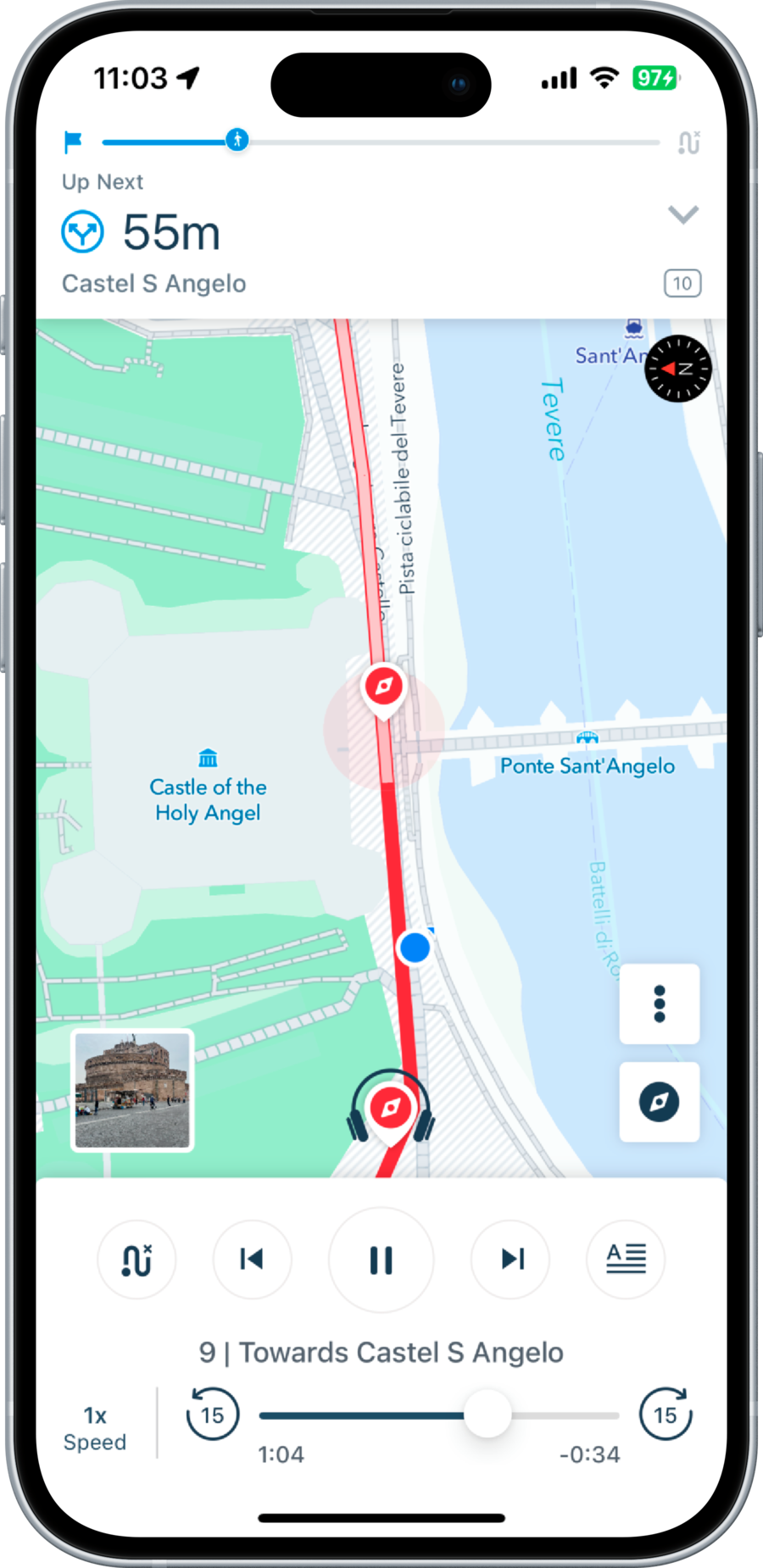
- Download tours to use them offline
- Listen hands-free with GPS playback
- Get turn-by-turn directions


Scan to get app
Download the app for free
VoiceMap




 App of the Day

 Editor’s Choice

Best Paris tours for sense of place
Tours that truly immerse you in your surroundings


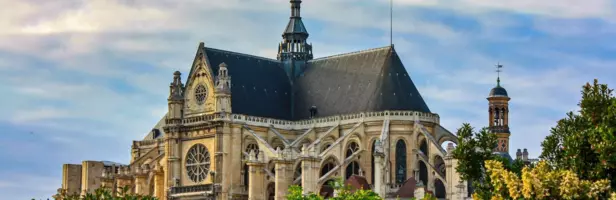

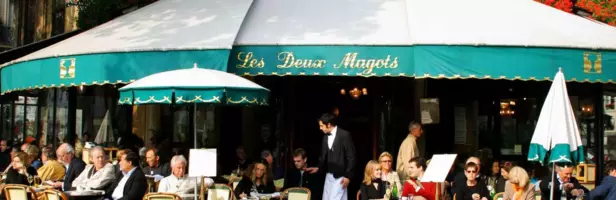
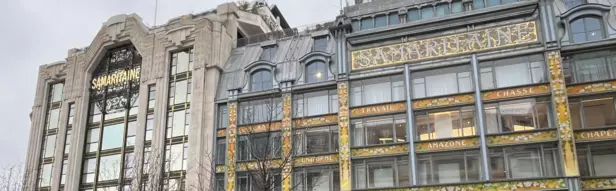

Paris attractions on our audio guides
-
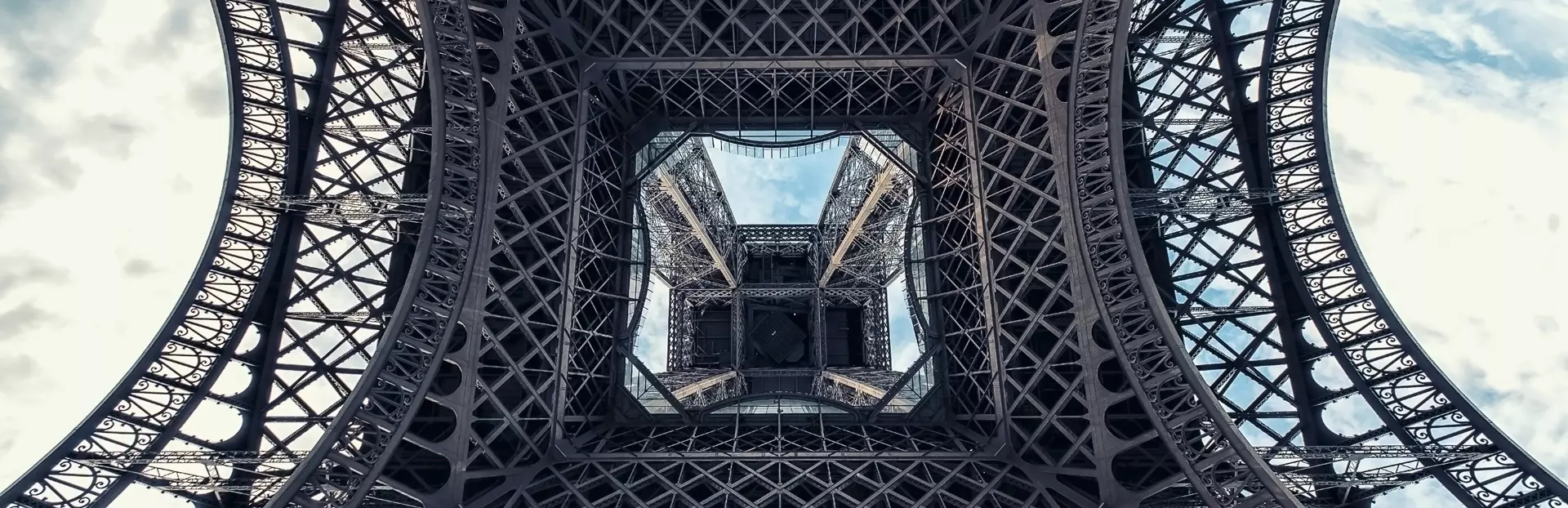
 The Eiffel Tower
Paris
The Eiffel Tower
Paris
 Featured on 3 routes
-
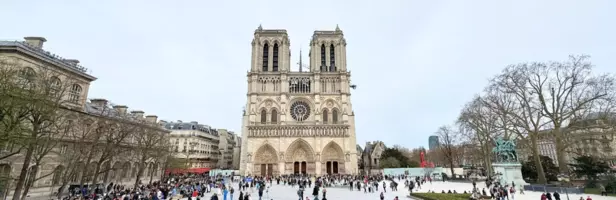
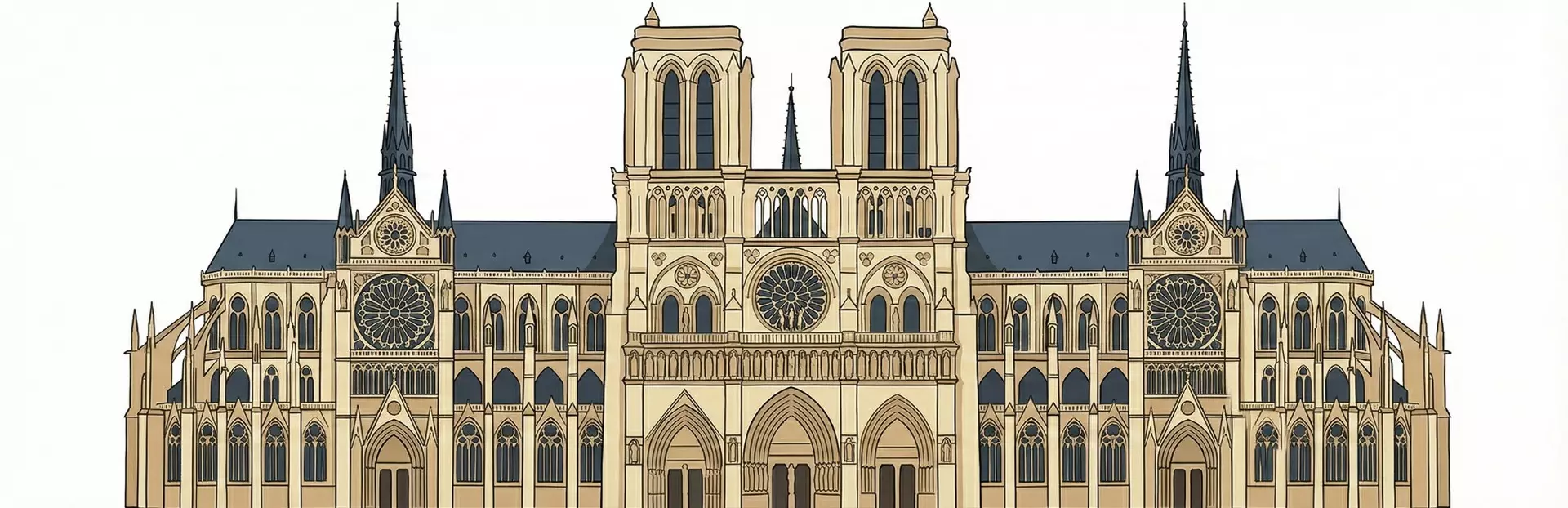 Cathédrale Notre-Dame
Paris
Featured on 6 routes
Cathédrale Notre-Dame
Paris
Featured on 6 routes
-
 Sacré-Cœur Basilica
Paris
Featured on 2 routes
Sacré-Cœur Basilica
Paris
Featured on 2 routes
-
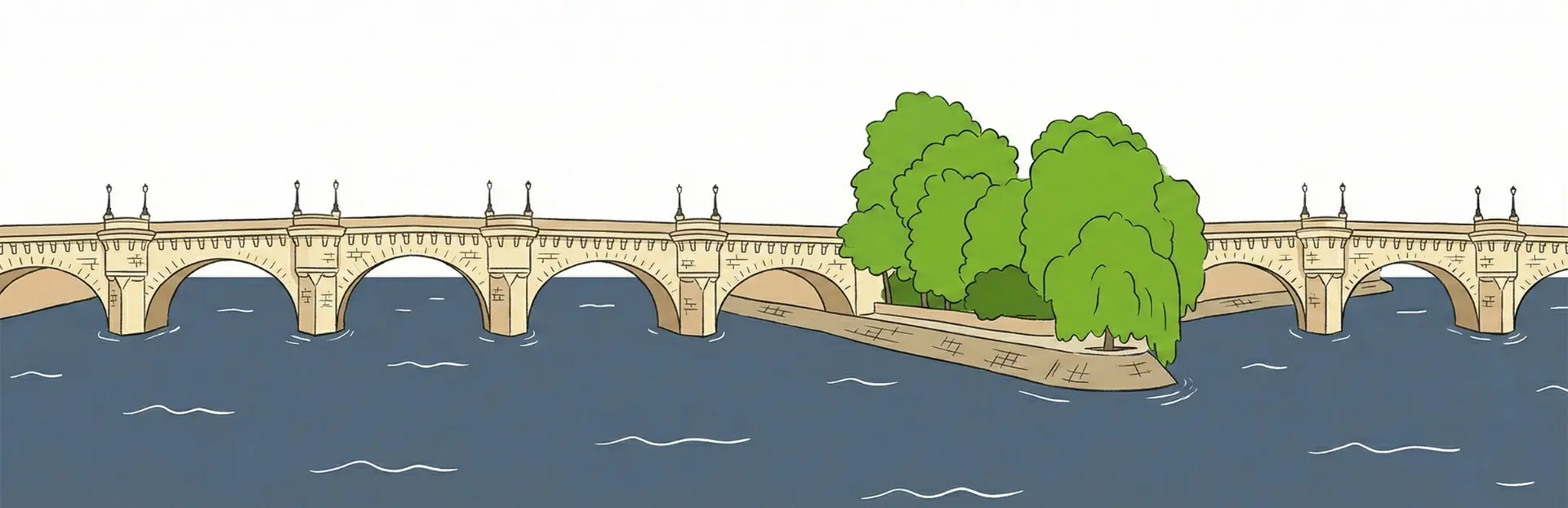 Pont Neuf
Paris
Featured on 3 routes
Pont Neuf
Paris
Featured on 3 routes
-
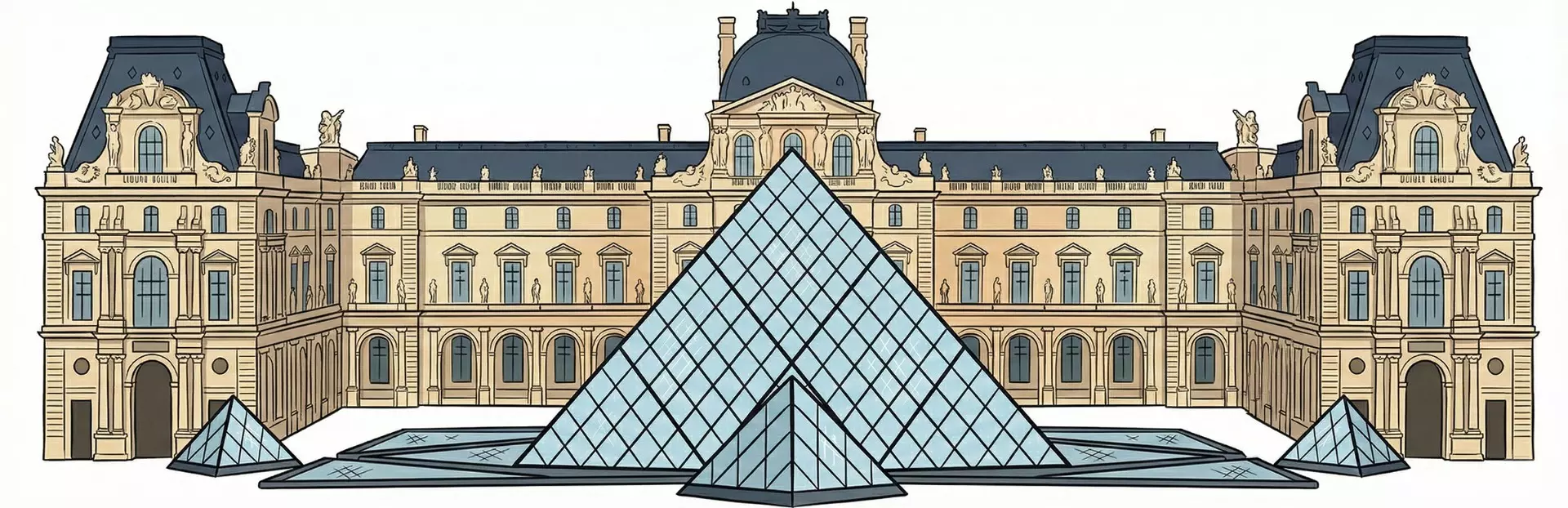 Louvre Museum
Paris
Featured on 3 routes
Louvre Museum
Paris
Featured on 3 routes
-
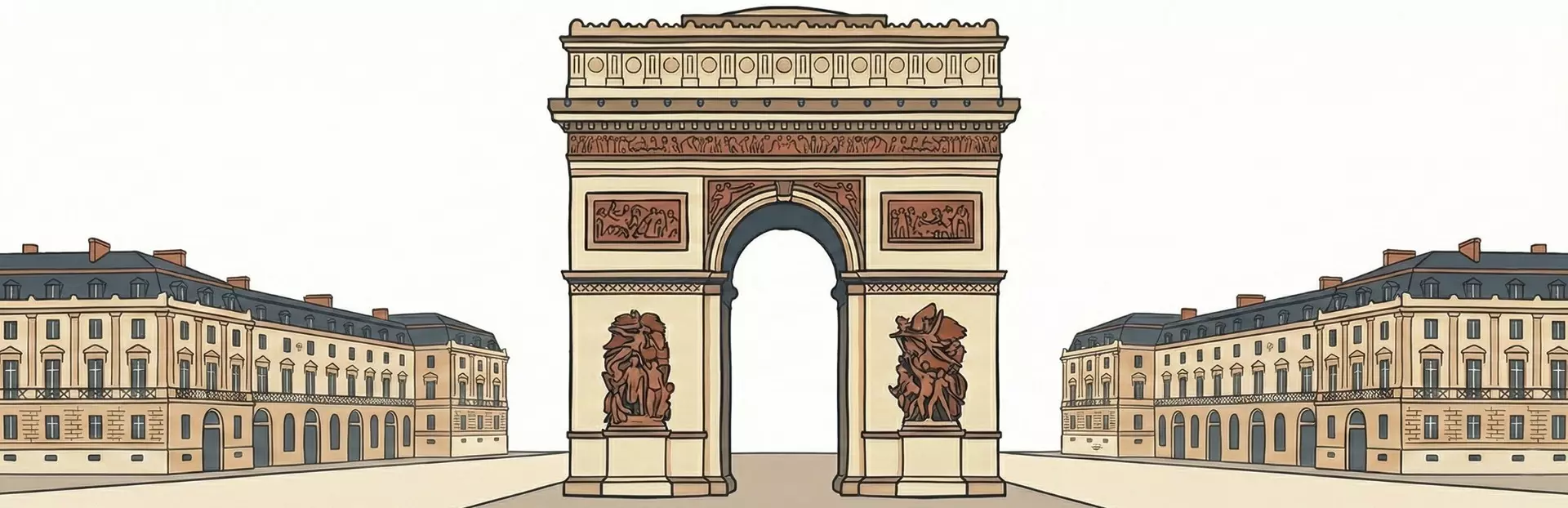 Arc de Triomphe
Paris
Featured on 3 routes
Arc de Triomphe
Paris
Featured on 3 routes
-
 The Panthéon
Paris
Featured on 3 routes
The Panthéon
Paris
Featured on 3 routes
-
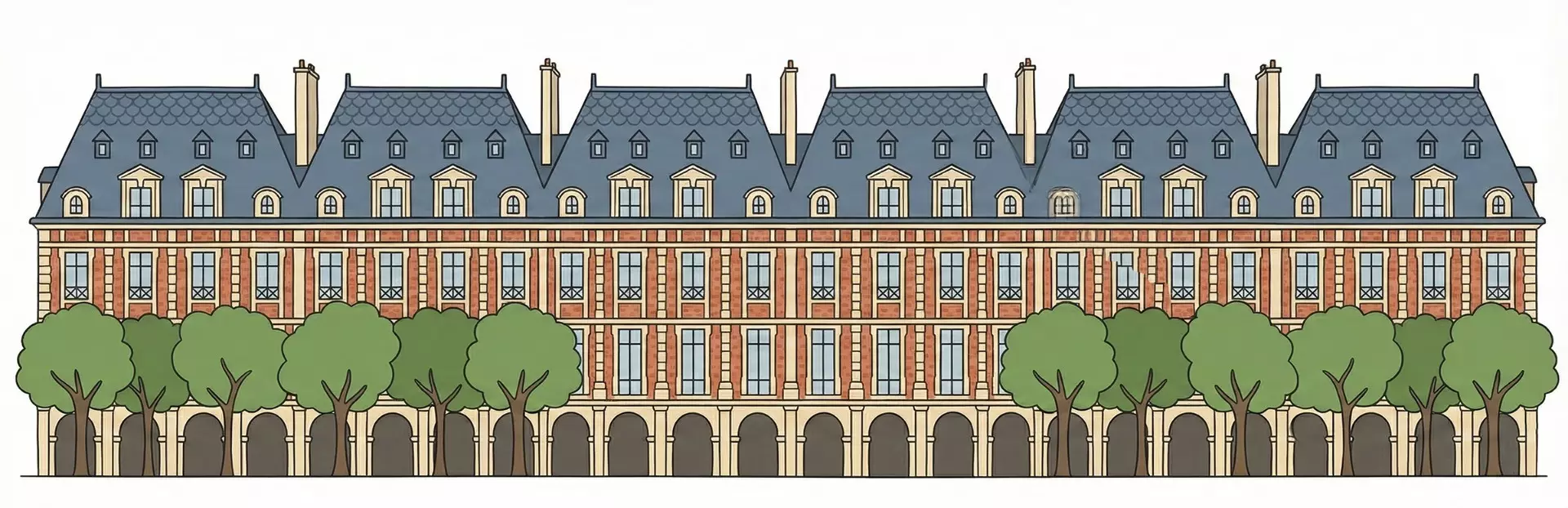 Place des Vosges
Paris
Featured on 5 routes
Place des Vosges
Paris
Featured on 5 routes
Top-rated audio tours in Paris
-
 Paris
Paris
-
 Paris
Paris
-
 Paris
Paris
-
-
-
-
-
-
 Top Rated
See all
Top Rated
See all
Audio guides by local experts





Paris tours about Pop Culture

-
Paris
-
Paris
-
-
 Paris
Paris
-
 Paris
Paris
-
-
 Paris
Paris
-
 Pop Culture
See all
Pop Culture
See all
How the VoiceMap app works
-
Focus on your surroundings, not the screen
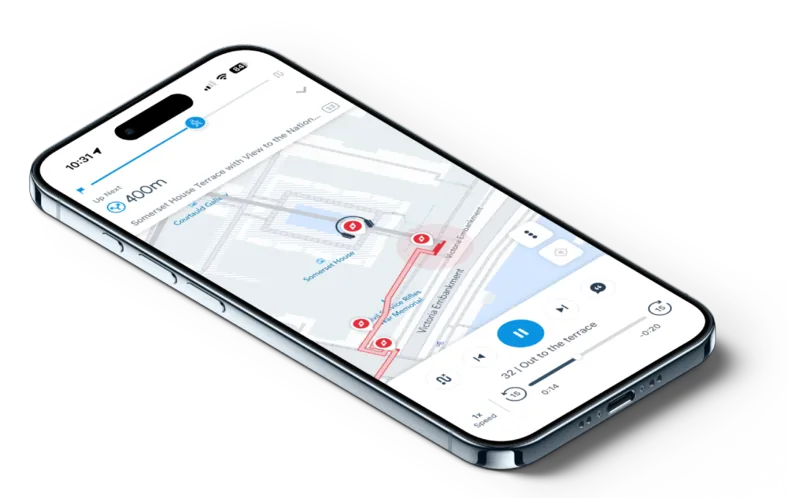
The VoiceMap app uses GPS to play audio automatically, at the right time and place, so you can focus on your surroundings, not the screen.

-
Follow a route with turn-by-turn-directions
VoiceMap tours follow a route from a fixed starting point. That lets us give turn-by-turn directions and use context to tell a better story.

-
Resume playback to go at your own pace
If you'd like to stop for a drink or go into a museum, end your tour then use the Resume feature to pick up exactly where you left off.
-
Listen as many times as you like
You can listen to your tours as often as you like using both the VoiceMap app and website.

-
Take virtual tours anywhere, like a podcast
Select Virtual mode in the VoiceMap app to listen to tours like a podcast - at home or in transit.

-
Buy for less on voicemap.me and sync
Once you've purchased a tour, it's added to your VoiceMap library. To access it in the app, just sign in using the same account.

-
Do tours without paying for data
Tours work offline, so you don't have to pay roaming fees. Just download them over WiFi before you get started.

Self-guided walking tours in Paris
-
Paris
-
Paris
-
Paris
-
-
-
-
-
-
 Walk
See all
Walk
See all
Nearby destinations




Explore more with VoiceMap
-
Get a group discount
Get 15% to 50% off when you buy for a group

-

-



Frequently Asked Questions


Start on the Île de la Cité. It's the geographic and historical heart of the city – the small island in the Seine where Paris began as a Roman settlement 2,000 years ago, and where Notre-Dame, Sainte-Chapelle, and the Conciergerie all stand within a few hundred metres of each other. Walking onto the island gives you an immediate orientation: you can see the river on both sides, understand the city's relationship to water, and get a sense of the Left Bank and Right Bank before you've committed to either.
The instinct to rush between the Eiffel Tower, the Louvre, and Notre-Dame all on day one is understandable but worth resisting. Each of those sites deserves more than the hour you'll give it if you're trying to see all three. A better first day picks one area and goes deep. The Île de la Cité, the Marais, or the Latin Quarter each offer two to three hours of absorbing walking without requiring any pre-booked tickets.
You don't have to see the Louvre. You don't have to go up the Eiffel Tower. Paris is one of the few cities in the world where the experience of simply walking through a neighbourhood – the pavé, the boulangeries, the light on the Seine – is itself the attraction. Some of the most memorable Paris trips involve one major museum, two neighbourhood walks, and a lot of sitting in cafés.
Annie Sargent's Île de la Cité: Where Paris Was Born ($14.99) is the natural first tour for anyone arriving in the city. It covers 2,000 years of history across two hours, from the Knights Templar to Quasimodo to Charles de Gaulle, and leaves you with a framework for everything you see afterwards.
Paris is smaller than first-time visitors often expect, and the central sights are genuinely close to each other. Notre-Dame to the Louvre is about 1.4km – a 20-minute walk. The Marais to Sacré-Cœur is 4km, manageable on the Métro in 15 minutes. The Eiffel Tower to Montparnasse is 2.5km. In theory, you could touch four or five major sites in a single day.
In practice, the experience of doing so is usually thin. Queue times, security checks, and the sheer scale of sites like the Louvre mean that a day built around multiple icons often leaves you exhausted and underwhelmed by each one. The Louvre alone holds 35,000 works across several kilometres of corridors; a two-hour visit barely scratches the surface.
A more satisfying approach is to pick one major site per half-day and build the rest of the time around the neighbourhood surrounding it. If you're going to Notre-Dame in the morning, spend the afternoon on the Île de la Cité and the adjacent Latin Quarter rather than rushing to Montmartre. If you're in the Marais for a walking tour, stay for lunch and the Musée Carnavalet (free) rather than immediately heading to the Eiffel Tower.
VoiceMap's tours are designed with this kind of depth in mind – most run 45–150 minutes and cover a specific neighbourhood or theme rather than trying to sprint between icons. Annie Sargent's Île de la Cité: Where Paris Was Born ($14.99) is a two-hour walk through the island that anchors the city's geography and 2,000 years of history – the natural starting point before branching out.
For the most popular Paris attractions, advance booking isn't optional – it's the difference between getting in and standing in a queue for three hours only to be turned away. The Eiffel Tower, Sainte-Chapelle, the Catacombs, and the Louvre all have timed-entry systems; without a pre-booked slot, you join the walk-up queue and take your chances. At the Eiffel Tower, buying tickets through the official app (toureiffel.paris) once you're on-site is often faster than the ticket desk queue – there are QR codes at the security entrance that take you straight to it. For the Louvre, early morning on a Wednesday or Friday (when it stays open until 9:45pm) sees the thinnest crowds.
Notre-Dame is a useful exception: entry is free, and timed slots are released progressively up to two days in advance through the official site at notredamedeparis.fr. Late afternoon visits – after 4pm – are generally quieter without any reservation at all.
Group tours with skip-the-line access are worth considering honestly: they can secure ticket allocations that aren't available through general booking, and at a site like the Louvre, having someone navigate you through 60,000 square metres is genuinely useful. The trade-off is inflexibility – you're locked to their schedule and their pace.
Self-guided audio tours require no booking at all. VoiceMap's Paris tours are available on demand – download one over breakfast, start whenever you like, and skip attractions that have a bad queue day entirely. For the Eiffel Tower specifically, Annie Sargent's Paris' Iron Lady ($14.99) gives detailed insider advice on the fastest entry route: the left-hand entrance is consistently shorter, and the tower is quietest in the first hour after opening at 9:30am.
Paris is one of the most well-documented cities in the world, which means independent exploration is genuinely viable in a way it isn't everywhere. Signage is good, museums have audioguides, and the city's density means you'll stumble into interesting things almost regardless of what you do. For wandering the Marais backstreets, sitting in the Luxembourg Garden, or following the Seine between bridges, you don't need a guide of any kind.
Where a guided tour earns its place is at sites with real interpretive complexity – the Louvre, Sainte-Chapelle, Versailles – where the context around what you're looking at is half the experience. A good guide at the Louvre can navigate you past the tourist bottlenecks straight to works that most visitors miss entirely, and give you a framework that makes the collection comprehensible rather than overwhelming.
Group tours also have a practical advantage at the most popular Paris attractions: some operators have access to separate ticket allocations, so booking a guided visit can be the difference between getting in on a busy day and not. For the Eiffel Tower, the Catacombs, or the Louvre in July, that matters.
Self-guided audio tours sit in the middle: you get the narrative depth of a guided experience with the flexibility to move at your own pace. VoiceMap's Paris tours range from $0 (three free tours of American revolutionary sites by the Rochambeau Chapter DAR) to $19.99 (Context Travel's expert-led walks), and cover everything from the Île de la Cité to Montmartre to Les Halles. The flexibility is the point – start when you want, pause for coffee, replay sections you missed. You're exploring with a knowledgeable friend in your ear, not following an umbrella through a crowd.
Notre-Dame reopened in December 2024 after five years of restoration following the 2019 fire, and it is genuinely worth seeing. The cathedral's interior has been cleaned and restored to a brilliance that even regular visitors have never seen – centuries of soot and grime removed to reveal the original colours the medieval builders intended.
Entry to the cathedral is free, but during busy periods the walk-up queue can stretch to two or three hours. The solution is a free timed slot, bookable up to two days in advance through the official website at notredamedeparis.fr. Slots are released at midnight Paris time and disappear quickly on peak days; if you don't find anything, check again a few hours later as new slots are added progressively. Late afternoon visits – after 4pm – tend to be quieter if you haven't pre-booked. The Bell Towers require a separate paid ticket (€16 for adults, free under 18), and the Archaeological Crypt (€4) needs its own booking. Modest clothing is required inside, and security screening at the entrance adds 10–20 minutes.
VoiceMap has three indoor tours of Notre-Dame, all using tap-to-play navigation rather than GPS – you move through the interior at your own pace using reference photos and tap to hear commentary at each stop. Annie Sargent's Paris' Gothic Jewels ($14.99) covers Notre-Dame, Sainte-Chapelle, and the Conciergerie across two hours. Renovation, Restoration and Rebirth ($19.99) by Context Travel is narrated by Lindsey Hansen, an art historian specialising in medieval French Gothic architecture. Sixpence's Victor Hugo's Notre Dame ($8.99) approaches the cathedral through Hugo's 1831 novel – the book that saved it from demolition.
Quite a lot, and in some cases it's more rewarding. The reflex to tick off the three main icons can leave visitors spending most of their trip in queues rather than actually experiencing the city.
Père Lachaise cemetery is one of Paris's most distinctive and undervisited spaces – 44 hectares of ornate tombs, cobbled lanes, and more than a million residents, among them Chopin, Proust, Molière, Edith Piaf, Oscar Wilde, and Jim Morrison. It has to be navigated: Joe Start's three-part VoiceMap series covers it in detail, tracing the lives and unlikely afterlives of its most compelling residents across Part I, Part II, and Part III.
The Musée Carnavalet in the Marais is free and houses over 600,000 objects tracing Paris's history: Marie Antoinette's hair, Voltaire's armchair, Marcel Proust's brass bed, and a Neolithic canoe pulled from the Seine. The Jardin du Palais-Royal – tucked behind arcades in the 1st arrondissement – is the sort of place you can walk past a hundred times without realising it exists, with a history running from Cardinal Richelieu to Revolutionary plotting to Daniel Buren's controversial striped columns. The covered shopping passages of the 2nd arrondissement, particularly the Galerie Vivienne with its mosaic floors, feel like time travel.
For a change of pace, the 14th arrondissement's Parc Montsouris and the backstreets above the Catacombs offer a neighbourhood Paris that has nothing to do with tourist infrastructure. VoiceMap's Highlights Around Parc Montsouris ($11.99) covers this territory in detail.
The honest answer is: go early. By 10am on a summer weekend, the main approach to Sacré-Cœur – the wide staircase from Place Saint-Pierre – is shoulder-to-shoulder. By 7am, you'll have the hilltop almost to yourself. The light is better anyway: the white travertine of the basilica catches the morning sun in a way the midday glare never does.
Entering from the north rather than the south also changes the experience significantly. Coming up through the back streets from Lamarck-Caulaincourt Métro station, rather than Anvers or Abbesses, puts you on the quiet residential side of the hill before the tour groups have arrived. The vineyard at Vigne du Clos Montmartre, Cabaret au Lapin Agile, and the narrow streets around Rue Lepic all feel like a genuine neighbourhood at this hour rather than a stage set.
Two practical warnings: Montmartre is hilly, and most of its streets are cobblestone, which means comfortable flat-soled shoes matter more here than almost anywhere else in Paris. And pickpockets are a real issue around Sacré-Cœur and at the Trocadéro approach – keep belongings secure and don't engage with anyone asking you to sign a petition.
Annie Sargent's Montmartre: More than Meets the Eye ($14.99) and Context Travel's Paris' Modern Art Mecca ($19.99) both cover the neighbourhood's bohemian history, from the artists' studios where Picasso developed Cubism to the 1871 Commune that erupted on this very hill. Starting either tour before 9am means the commentary plays against the city rather than crowd noise.
The 14th arrondissement, south of Montparnasse, is one of Paris's least touristy and most characterful areas. The streets above the Catacombs entrance – explored in Comte de Saint-Germain's Above the Catacombs in Lupin's Footsteps ($11.99) – wind past the Santé prison, the Paris Observatory, and the old maternity hospital at Port-Royal, with almost no tourist infrastructure. The same publisher's Highlights Around Parc Montsouris ($11.99) covers the bucolic streets around the park in the same arrondissement – hidden aqueducts, artists' villas, and a neighbourhood that feels genuinely Parisian rather than performed.
Belleville and Ménilmontant in the 20th arrondissement are the other obvious answer. Jennifer Solheim's Flâneurs of Belleville ($7.99) – created by a French and Francophone literature scholar – uses the neighbourhood as a meditation on flânerie itself: how to wander a city and read it like a storybook, moving between historically rich streets and contemporary street art.
The 16th arrondissement around Rue La Fontaine is the least-known of the three – a neighbourhood of extraordinary Art Nouveau architecture, including Hector Guimard's Castel Béranger, that most Paris visitors have never heard of. VoiceMap's Art Nouveau and Modernist Architecture ($9.99) covers it with Le Corbusier's Villa La Roche as a bonus stop.
Walking is by far the most rewarding way to experience central Paris, and the central arrondissements are compact enough that most of the famous sites are within 20–30 minutes of each other on foot. The walk from Notre-Dame to the Marais takes 15 minutes; from the Louvre to the Eiffel Tower is about 40 minutes along the Seine. The streets between major landmarks are half the point of being there.
The Métro fills the gaps efficiently. Lines 1 and 4 cover the main tourist corridor, and the system is easy to navigate with a downloaded map. Single tickets are more expensive than a day pass if you're making more than a few journeys – the Navigo Easy card, available at any station, is the most convenient option for short visits, loading either day passes or blocks of individual tickets. The RER B connects Charles de Gaulle airport to central Paris; the RER C runs along the Left Bank and connects to Versailles.
Vélib', Paris's bike-share scheme, is a good option for experienced urban cyclists and covers most of the city with around 1,400 docking stations. The central arrondissements have dedicated cycle lanes on most major streets, though traffic is dense and confidence helps. Electric scooters (Lime, Dott, Tier) are plentiful but banned from pavements and officially limited to designated lanes.
Taxis and Uber are reliable and reasonably priced by Western European standards, though rush-hour traffic in central Paris can be brutal. For cross-city journeys between areas not well-served by the Métro they're useful; for short hops within the centre, you'll almost always be faster on foot.
One practical note for anyone planning to use a self-guided audio tour: VoiceMap's Paris tours work offline once downloaded, so you don't need mobile data or a local SIM while you're walking. Download over Wi-Fi before you leave your accommodation and the GPS triggers automatically as you move through the route – no connectivity needed mid-tour.
Paris's arrondissement system creates real differences in what staying somewhere feels like, and the neighbourhood does matter – but perhaps not in the way most planning guides suggest. The question isn't only about proximity to major sights; it's about what kind of city you want to wake up in.
The Marais (3rd and 4th arrondissements) is dense, walkable, and historically layered – medieval mansions alongside the Jewish quarter, alongside the city's LGBTQ+ hub. It puts you within easy walking distance of Notre-Dame, the Place des Vosges, and the Pompidou. Saint-Germain-des-Prés (6th) is the classic literary Left Bank: comfortable and beautifully formed, with the Luxembourg Garden a few minutes away. It suits visitors who want to eat, walk, and feel Parisian rather than tourist-adjacent. The Latin Quarter (5th) is more affordable and more mixed; it has the energy of a university neighbourhood alongside its ancient streets.
One practical note: Paris's Métro is good enough that you're rarely more than 20 minutes from anywhere. If you find a flat in a neighbourhood you love, the distance to major sights is unlikely to ruin your trip. VoiceMap's Paris tours are also spread across the city's arrondissements – from the Île de la Cité and the Marais to Montmartre, the Latin Quarter, Saint-Germain, and the 14th – so whatever neighbourhood you're based in, there's likely a tour that starts close to your door.
Paris has a reputation for expense that its free offerings don't always reflect. The Musée Carnavalet – Paris's own city history museum, housed in two Renaissance mansions in the Marais – has free permanent admission and is genuinely world-class: Marie Antoinette's hair, Voltaire's armchair, Proust's brass bed. The Musée d'Art Moderne de Paris is also free. On the first Sunday of each month, the Louvre, the Musée d'Orsay, and most national museums waive their entry fees entirely – worth building an itinerary around if your dates align.
The Jardin du Luxembourg, the Palais Royal gardens, and the Tuileries are free and offer something no museum can: the experience of simply being in Paris without paying for it.
For audio tours, VoiceMap's Paris range starts at $0 – the Rochambeau Chapter DAR's three free tours cover Benjamin Franklin's Paris, Thomas Jefferson's time in the city, and the Marquis de Lafayette's story. Independent publisher tours sit mostly in the $7.99–$14.99 range, considerably less than a group walking tour; Paris Walks charges €25 per person for their scheduled group tours, and small-group museum tours (Louvre, Orsay) typically run €80 per person. The depth and local knowledge in VoiceMap's catalogue – publishers include working journalists, authors who have lived in Paris for decades, and Context Travel's PhD-level scholars – is genuine rather than a consolation prize for paying less.
Eating cheaply without eating badly: boulangeries are the answer. A proper lunch in Paris can be a €4 croque-monsieur from a good bakery, eaten on a bench by the Seine.
Paris works extremely well for solo travel. The city's café culture is built for sitting alone – no one finds it unusual or uncomfortable, and the French habit of eating at the bar makes solo meals feel natural rather than awkward. The dense concentration of things to look at and think about means there's no pressure to fill silence with company.
For solo women specifically, Paris is considered one of the safer major European cities. The main concern in tourist areas is pickpocketing, not personal safety – particularly around the Trocadéro, Sacré-Cœur, and the Pont des Arts. The petition scam at major monuments (someone approaching you to sign what looks like a charitable petition, while an accomplice lifts your phone or wallet) is worth knowing about; ignoring anyone who approaches you this way is straightforward prevention. Neighbourhoods like Saint-Germain, the Marais, Montmartre, and the Latin Quarter all feel lively and well-populated well into the evening. The area around Gare du Nord and Gare de l'Est is worth a little more awareness late at night.
Self-guided audio tours fit solo travel naturally. You're walking through the city with headphones on, indistinguishable from any other visitor or local – there's none of the self-consciousness that can come with joining a group tour alone. VoiceMap's Paris catalogue has tours to suit a solo day at almost any pace, from Annie Sargent's 45-minute Paris' Iron Lady to her two-and-a-half-hour Saint-Germain-des-Prés deep dive.
Paris rewards the second or third visit more than almost any city, because the interesting material runs much deeper than the icons.
For history with real darkness to it, the WWII occupation layer of Paris is extraordinary and largely unmarked. Context Travel's Occupation and Liberation ($19.99), narrated by novelist and Paris resident Samuél Lopez-Barrantes, traces the Nazi occupation of the Left Bank – the Hôtel Lutetia as counter-intelligence headquarters, the police commissariat that collaborated in Jewish deportations, the narrow streets where resistance fighters barricaded themselves in August 1944. It covers history that French public memory was largely silent about until 1995. The Mémorial de la Shoah in the Marais is free and among the most serious memorial museums in Europe; the Rue des Rosiers, where the Jewish quarter's texture survives most visibly, runs directly from it.
For film and TV location hunters, FrancoAmericana's Emily in Paris Tour ($9.99) is a 90-minute walk covering the show's real filming locations, from Emily's apartment at Place de l'Estrapade to Gabriel's restaurant and the Café de Flore. Sixpence's Before Sunset ($8.99) traces the 1995 film's locations – the Seine bookstalls, Café Marly, Shakespeare and Company.
For something further off the radar, Père Lachaise repays a second and third visit beyond the Morrison pilgrimage. Chopin's tomb has a weeping marble muse; Molière and La Fontaine may or may not be authentic; Oscar Wilde's monument now has protective glass after decades of lipstick kisses. Joe Start's three-part VoiceMap series covers all of it in genuine depth.
The gap between romantic Paris and tourist Paris is wider than most visitors expect, and closing it is mostly about resisting the obvious. The Eiffel Tower at peak hour, the queue at the Louvre, and a restaurant next to Notre-Dame are not romantic experiences – they are shared experiences with thousands of other people doing exactly the same thing at exactly the same moment.
The version of Paris that earns the reputation is quieter, earlier, and further from the main monuments. The Luxembourg Garden at 8am, before the crowds arrive and while the light is still low. The Palais Royal gardens on a Tuesday morning – Cardinal Richelieu's old backyard, tucked behind arcades in the 1st arrondissement, one of the most beautiful and least-visited spaces in central Paris. The backstreets of the Marais between Rue de Bretagne and the Place des Vosges in the early evening, when the light catches the brick pavilions that Henri IV built in 1612 and the restaurants are just beginning to fill.
For a specific tour, Sixpence's Before Sunset ($8.99) is a 60-minute walk structured around Richard Linklater's 1995 film – a tour designed around the idea of wandering a city with someone you want to keep talking to, covering the Seine bookstalls, Café Marly, and Shakespeare and Company. Gary Kraut's Luxembourg Garden ($9.99) is narrated by someone who has lived in Paris for over 35 years and treats the garden as a way of life rather than a sight to tick off.
VoiceMap tours are priced per device, which means a couple can share audio from one phone using a splitter or Bluetooth headphones – you hear the same thing at the same moment, which is a better version of the experience than one person ahead with headphones in.
The Eiffel Tower at night is worth doing once: the light show runs for five minutes on the hour after dark, and the Champ de Mars fills with people sitting on the grass watching it. It costs nothing and is genuinely lovely, crowds notwithstanding.
The honest starting point: the restaurants closest to major tourist sites in Paris are rarely the best ones, and some actively prey on visitors. Anything within 200 metres of the Eiffel Tower, the Louvre entrance, or the main Montmartre staircase is worth approaching with scepticism – check recent reviews before sitting down.
The most reliable way to eat well is to go slightly off the tourist axis. In the Eiffel Tower area, Rue de la Bourdonnais, Rue Saint-Dominique, and Rue Cler have consistently good neighbourhood restaurants – Annie Sargent recommends L'Ami Jean, L'Auberge Bressane (for soufflés), and La Fontaine de Mars, all bookable via the ZenChef app. In the Marais, the streets around Rue de Bretagne and the Marché des Enfants Rouges (Paris's oldest covered market, dating to 1615) offer everything from Moroccan briouat to Japanese bento eaten standing up.
For a more structured introduction to Parisian food culture, VoiceMap has two tours worth knowing about. Annie Sargent's Savoring Paris: A Food Lover's Walk around Les Halles ($14.99) takes you through the neighbourhood that fed Paris for eight centuries, with practical guidance on what to buy where and how to navigate the city's food shops with confidence. Context Travel's Parisian Picnic: A Marais Food Tour ($19.99) is a 60-minute walk through the Marais's food landscape.
One caveat worth noting: food tours reference specific vendors and restaurants that may change. Check recent reviews for specific establishments before following recommendations to the letter – this is good practice for any food content, and a live guide has an advantage here in knowing what closed last week.
The literary Paris catalogue is unusually rich, which reflects how deeply the city's identity is entangled with writers who came here, stayed, and wrote their way into the canon.
The Montparnasse circuit is the natural starting point for anyone drawn to the 1920s expatriates. The cafés where Hemingway, Fitzgerald, and Gertrude Stein gathered – Closerie des Lilas, La Rotonde, Le Sélect, La Coupole – still exist, though the Deux Magots and Café de Flore have become something closer to tourist theatres. The better version of this experience is Philippa Campsie's Finding the Lost Generation in Montparnasse ($11.99) – Campsie is a writer and frequent Paris visitor who traces where the expatriates actually lived, loved, and fought, including the Hotel de Fleurus and Oscar Wilde's niece Dorothy, who is one of the era's genuinely lost voices. Context Travel's Hemingway's Paris ($19.99) is narrated by Samuél Lopez-Barrantes – a novelist, Sorbonne creative writing teacher, and Paris resident since 2008 – who deliberately unpicks the myths around Hemingway while tracing his actual footsteps through the Latin Quarter.
Victor Hugo's Paris runs deeper than most visitors realise. His apartment at number 6 Place des Vosges is now a museum. Sixpence's Victor Hugo's Notre Dame ($8.99) is a 60-minute indoor tour of the cathedral through the lens of his 1831 novel – the book that saved Notre-Dame from demolition.
Shakespeare and Company on the Left Bank is obligatory: not the original (that closed in 1941 when Sylvia Beach refused to sell her signed Joyce first edition to a Nazi officer), but the successor on Rue de la Bûcherie, which Hemingway, the Beat Generation, and half of literary Paris passed through. It's one of the few bookshops in the world where the history is as interesting as the stock.