





Diego Rivera in a New Light: A Living Museum of Muralism Guide




 Buy for a Group
 Reviews
 About the Tour
 About the Tour
The Museo Vivo del Muralismo houses Diego Rivera's most ambitious mural cycle—over 1,000 square meters of revolutionary frescoes covering three floors. On this self-guided museum tour, you'll decode 140 panels that depict Mexico's labor traditions, ethnically diverse celebrations, and revolutionary struggles. Through Mexican writer Diana Coronado's research into Rivera's life, you'll uncover stories about censored poems, artistic rivalries, and how the painter transformed Renaissance techniques into distinctly Mexican visual narratives.
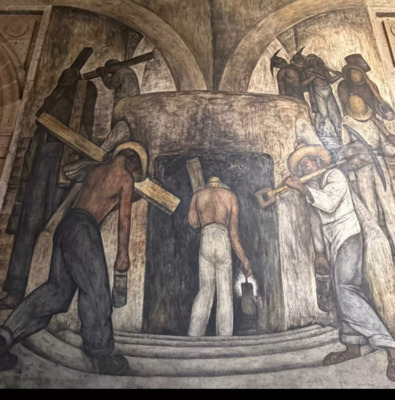
The tour begins at the museum entrance on the street of República de Argentina, in a building that has served as an Aztec school, a Spanish convent, and a revolutionary-era Ministry of Education. You'll explore the Court of Labour, where Rivera depicted weavers from Oaxaca, miners from Guanajuato, and potters from Jalisco—portraying native Mexicans as central figures and with authentic features for the first time, challenging elite expectations and sparking widespread controversy.
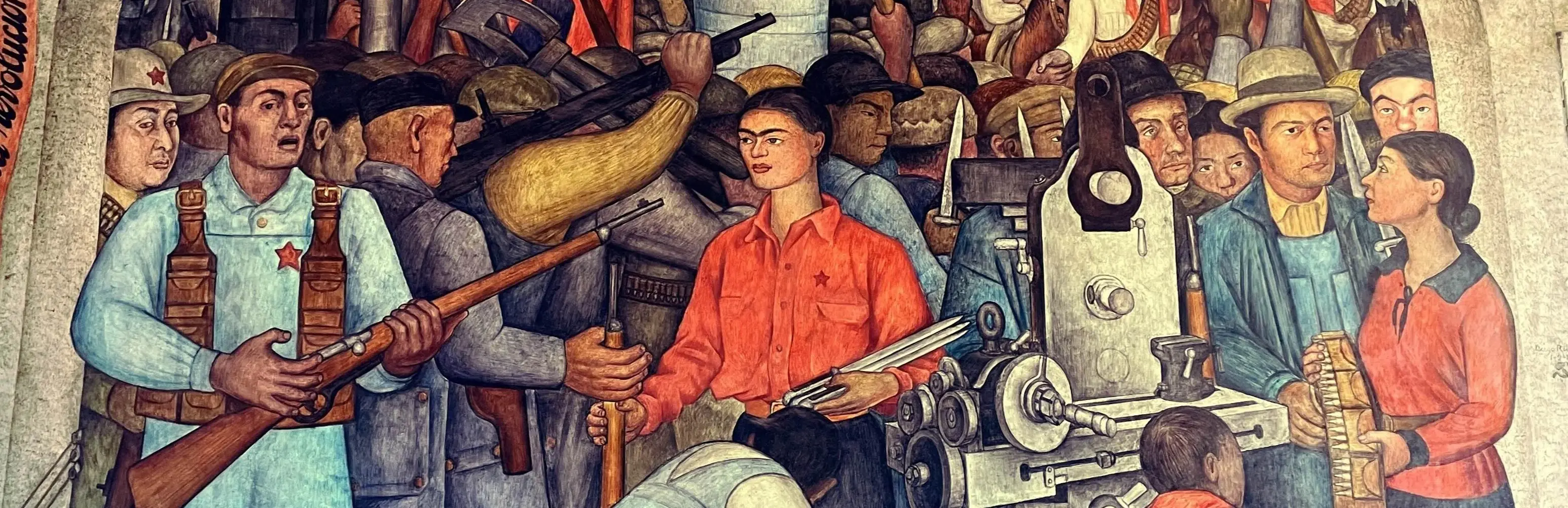
You'll ascend Rivera's spiral staircase, where water goddesses, Aztec gods, and masonry elements are portrayed. Reaching the third floor, martyred heroes—including Emiliano Zapata—appear as Buddhist-like deities. You'll identify a young Frida Kahlo holding a rifle in the Arsenal, spot Rivera's self-portraits, and watch his style evolve from historical compositions to political social art. The tour ends on the mezzanine level, where intellectual activities and state coats of arms appear in monochromatic grisaille.
On this 150-minute tour, you'll have a chance to:
- Find where the censored poem is hidden, sealed in a bottle, after Minister José Vasconcelos demanded its removal
- Stand before Mexico's first mural denouncing corporal punishment, composed like Christ's lamentation
- Learn who saved Rivera's career by teaching him ancestral fresco techniques
- Examine how he translated the theory of the montage of attractions used in cinema into mural art
- Discover how Rivera’s cubism techniques and Cezanne’s art conceptions are incorporated in his frescoes
- Decode the mural featuring Rockefeller, Ford, and JP Morgan that references the tale of King Midas
- Trace model and cultural bridge Luz Lozano's eight appearances in different murals
This tour reveals when Diego Rivera defined his artistic language, how the Revolutionaries were transformed into heroes, and where Mexico's visual identity was born.
Tour Producer
 Tour Producer

EnBiciArte Tours

Diana Coronado is a Mexican writer of children books, novels and movie scripts. She has lived in different continents and traveled to many countries. When she finds herself in a new place, she enjoys doing research to fully appreciate the uniqueness of every city.
Raúl Martínez is a bike expert and loves to ride through Mexico City not only to avoid traffic, but because it gives him the chance to appreciate hidden details otherwise unseen when driving. In 2019, along with his twin brother Jesús, he founded the bike shop Pedal & Crank, the best in the San Miguel Chapultepec neighborhood.
EnBiciArte was created because of their friendship and their shared love of Mexico City. They want to design interesting, entertaining and fresh tours that blend the expertise of each: writing and riding. They try to move away from trendy neighborhoods and into the city’s parks and streets which are full of art, history and barely known stories.
Save with Mexico City audio tour passes
How do passes work?

Preview Location
 Preview Location
Location 9
Entering the Mine
 View locations and route

How VoiceMap Works







Major Landmarks
 Major Landmarks
-
Museo Vivo del Muralismo
Getting There
 Getting There
Route Overview
-
Start locationCVP9+Q8, Mexico City, CDMX, Mexico
-
Total distance0m
-
Final locationCVP9+Q8, Mexico City, CDMX, Mexico
-
Distance back to start location0m


Directions to Starting Point
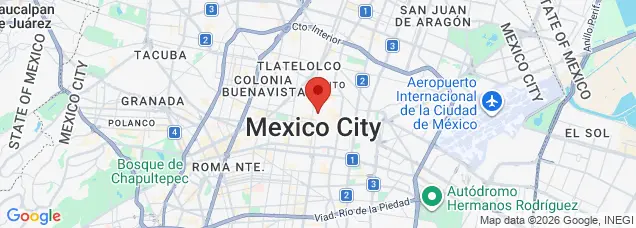
This tour begins in front of the Living Museum of Muralism. I recommend using public transportation to get there. The Alameda and Zócalo stations on the Blue Line are the closest.
You may also arrive by bicycle—just be sure to secure it properly.
If public transportation isn’t convenient, taking a taxi is a good alternative. Ask to be dropped off on Donceles Street and walk from there. Some of the streets around the museum are pedestrian-only, and traffic can be slow if you try to get dropped off right at the entrance.
If you’re arriving by car, it’s best to leave it in a nearby public parking lot and walk from there, such as the one on 5 de Mayo Street.
 Show Directions




Tips
 Tips
Tips
Places to stop along the way
Before heading to the museum, you might want to try a traditional—and good-value—Mexican breakfast at Café El Popular.
For lunch, you can visit Café de Tacuba, a 110-year-old restaurant located in the heart of the city. Housed in a former palatial residence in the Historic Center, its name later inspired the popular Mexican rock band Café Tacuba.
If you're looking for a quick and delicious bite, try El Rey del Pavo, a historic family-run restaurant that has specialized in turkey tacos and tortas (sandwiches) since 1910.
If you feel thirsty after the long visit, you might want to stop at Templo Mezcalería, hidden on the second floor on Donceles Street. Its balconies offer a refreshing spot to enjoy a beer or mezcal.
If you’re feeling more adventurous and want to try pulque, a traditional fermented beverage, visit the pulquería El Ombligo del Maguey on Donceles Street.
Best time of day
The Living Museum of Muralism is open from Wednesday to Sunday, from 10 a.m. to 6 p.m., and is closed on Tuesdays and public holidays.
Weekdays are ideal if you want to avoid crowds.
Precautions
Admission to the museum is free. Food and drinks are not allowed inside. Backpacks and bags must be checked at the cloakroom.
This tour takes between two and a half and three hours and focuses exclusively on Diego Rivera’s murals, but there is much more to see in the museum. You may want to allow at least three and a half hours or more to fully enjoy your visit.
Don’t forget to download the tour in advance using Wi-Fi. Bring your phone fully charged and headphones for a better experience.
Photography for personal use is allowed, but flash is prohibited. Live video streaming is not permitted. And most importantly—please do not touch the murals.
There are benches available inside the museum, but you will be standing for most of the tour. Wear comfortable shoes.
The decorated staircase at the first-floor entrance is sometimes closed. In that case, access the museum through the second floor and then descend to the first mural to begin the tour.
You will be walking through busy streets in downtown Mexico City. As in any large city, stay aware of your surroundings and take care of your belongings.
If you arrive by bicycle, make sure to secure it properly.
Get The App
 Get The App




Scan to get app
Download the app for free
VoiceMap




 App of the Day

 Editor’s Choice


 Last Updated
 Questions and Reviews