




Madrid Walking Tour: Manzanares River’s Story from Prehistory to Popular Park




 Buy for a Group
 Reviews
 About the Tour
 About the Tour
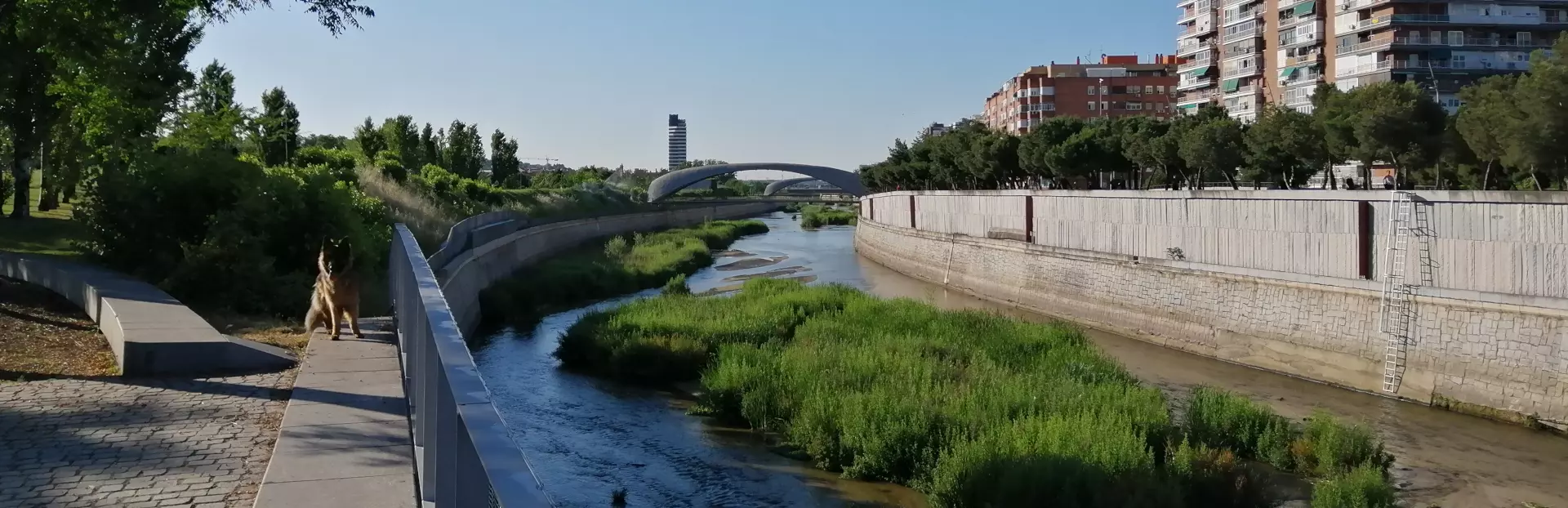
Winding through the southern part of the city like a green ribbon, Manzanares Rio Park is one of the newest public spaces in the capital, but also where the ancient history of Madrid begins. It’s a side of the city that few visitors get to see, as I discovered when I first moved here and started researching Manzanares River’s history. On this walking tour, I’ll share my findings including tales of meat markets, woolly mammoths and washerwomen!
If you’d like to escape for a while from the hustle and bustle of Madrid’s city centre, this is the tour for you!
Starting next to the Antiguo Depósito de Agua (water tower), you’ll stroll through Matadero Madrid, an old slaughterhouse and market now converted into a cultural centre. From there, you’ll promenade along the river and through Madrid Rio Park to Toledo Bridge. While you walk, I’ll share the area’s 300,000-year-long history. I’ll show you the city’s lesser-known sites including the Obelisco de la Castellana (Castellana Obelisk or Obelisk of the Arganzuela as it's also known) and the Arganzuela Footbridge.
On this tour, you can look forward to hearing about:
- The prehistoric wildlife that roamed the riverbanks
- How Madrid’s first settlers used the fertile river to survive
- King Felipe II’s plans to link up Madrid to the Atlantic Ocean by building a 20-kilometre-long canal
- Obelisco de la Castellana, a monument for a deposed Queen that’s moved multiple times
- The statues of San Isidro (Madrid’s patron saint who performed over 400 miracles) and his wife, Santa Maria
- How the riverbank turned from an unloved eyesore to a green space teeming with wildlife
If you’re new to the city, a seasoned explorer, or a local looking to explore a part of Madrid you might not have seen before, this tour is for you. This hour-long walk will introduce you to the river’s fascinating links to the history of Spain’s capital.
Tour Producer
 Tour Producer

Clare Starkie

I'm Clare, an ex-museum curator and specialist English teacher who loves exploring the lesser-known areas of Madrid.
After studying medieval history and archaeology, I was a museum curator in Sheffield, England, for over 20 years. Working with their internationally renowned metalwork collection (and lots of other objects too!), my specialism was the cutlery industry that made the city world-famous.
Over the course of my career, I've researched everything from Fijian barkcloth to pewter teapots, given talks on Chinese ivories and surgical instruments, and organised exhibitions on stainless steel and Japanese enamels.
You name it, I've probably researched it!
I moved to Spain in 2018 to start a new life, but of course, I couldn't just leave my love of history behind.
Living in the southern Madrid neighbourhood of Usera, I almost discovered the Manzanares River by accident. For the first few weeks, I wasn’t even aware that the city had a river, as none of the tourist literature or any walking tours really mentioned it.
So I decided that, as I couldn't take a river tour, I'd use my research skills and write one myself. After hours of walking up and down the river, multiple visits to my excellent local library and extensive research at several of the city’s museums, I've pieced together a fascinating timeline of this hidden gem. The Manzanares has been shaped by centuries of constant evolution, grand ambitions and a practical use that even surprises people who have lived here for years.
Now I'm an English teacher for people in the heritage sector, and I continue to share my knowledge of the museum world with students from dozens of countries. I also love to investigate Spanish history and to share fascinating facts and exciting stories on my tours of the city. When I'm not delving into the past, I love walking in the Sierra Mountains, doing dance classes, and playing board games (of course, I like the history-based ones the most!).
Save with Madrid, Spain audio tour passes
How do passes work?

Preview Location
 Preview Location
Location 7
The Manzanares River
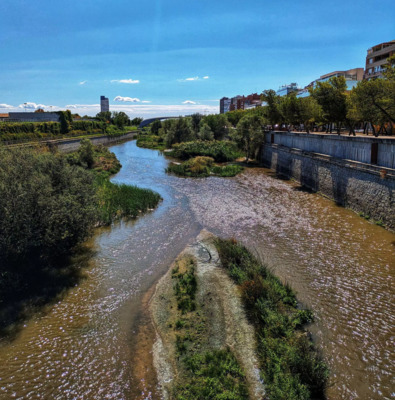
The source of the river is the Ventisquero de la Condesa mountains in the Sierra de ...
 View locations and route

How VoiceMap Works







Major Landmarks
 Major Landmarks
-
Antiguo Depósito de Agua
-
Matadero Madrid
-
Greenhouse Crystal Palace of Arganzuela
-
Puente de la Presa 8
-
Madrid Río Beach
-
Fuente del Obelisco
-
Obelisco de la Castellana
-
Toboganes de Madrid Río
-
Parque Madrid Río

-
Puente de Arganzuela
-
Toledo Bridge
-
Hornacina de Santa María de la Cabeza
-
Hornacina de San Isidro con su hijo
-
Hornacina de San Isidro y Santa María de la Cabeza
Getting There
 Getting There
Route Overview
-
Start locationPl. de Legazpi, 8, Arganzuela, 28045 Madrid, Spain
-
Total distance3km
-
Final locationPuente de Toledo, Carabanchel, 28019 Madrid, Spain
-
Distance back to start location2km


Directions to Starting Point
The starting point is at the Matadero centre, Plaza de Legazpi, 8, 28045 Madrid.
The best way to get there is to go to Legazpi Metro station on Line 3 (the yellow one) or Line 6 (the grey one).
Head out of the station at the Rio exit and you'll be on the opposite side of a roundabout to the Matadero's main entrance. Cross over the Paseo de las Delicias and then the Paseo de la Chopera roads to your right, heading for a big water tower with MATADERO written on in big letters, this is your starting point.
 Show Directions



Tips
 Tips
Tips
Places to stop along the way
The Plaza Rio 2 has plenty of cafes and restaurants and you'll pass a Cafe along the tour route if you need a snack. There is lots of seating along the route (as well as drinking fountains), so you can bring your own food and drink to eat.
If there are exhibitions and live events at the Matadero, they are worth a visit and are often free. It's open from 9.00 until 22.00 everyday.
Next to the Matadero there is the Crystal Palace Botanical Garden, a large indoor space with tropical plants. It's open 9.00 until 14.00 Tuesday to Friday and 10.00 until 14.00 Saturday and Sunday.
Best time of day
You can do the tour anytime between 9.00 and 22.00 when the Matadero is open. It's better during the day so you can see the monuments and wildlife in the river. The park gets pretty busy on the weekends, but not so much that you can't do the tour.
Precautions
I'd recommend bringing a water bottle and sunblock if it's a sunny day as there isn't a lot of shade along the paths.
Get The App
 Get The App




Scan to get app
Download the app for free
VoiceMap




 App of the Day

 Editor’s Choice


Questions and Reviews
 Questions and Reviews