The Roman Jewish Ghetto




 Buy for a Group
 Reviews
 About the Tour
 About the Tour
Rome's Jewish community is the oldest in Europe, predating the city's empire and outlasting its fall. On this walking tour through the Roman Jewish Ghetto, you'll trace more than 2,000 years of survival, from ancient slavery and papal persecution to deportation, emancipation, and the extraordinary cuisine that emerged from centuries of poverty.
The tour starts on Via Arenula, at the gateway to the Ghetto. You'll enter through a circular metal gate and walk the same narrow streets where thousands of Jews lived under papal rule for over 300 years – forbidden to own property, forced to wear yellow in public, and locked behind gates each night. Along the way, you'll pass the Fontana della Pianta, a 1590s marble fountain rescued from the demolished Piazza Giudea, and explore Via della Reginella, a dark, twisting lane that still feels like the Ghetto it once was.
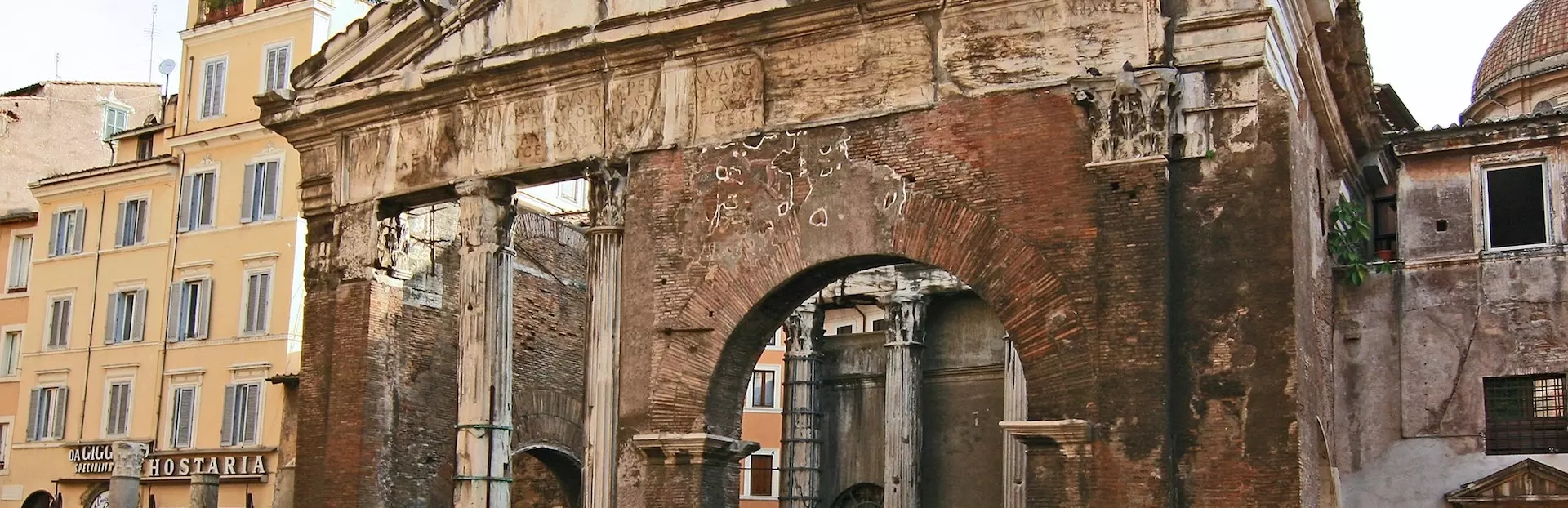
The tour continues down Via Portico D'Ottavia, pausing at Boccione bakery and the restaurants that have made this one of Rome's top culinary destinations, before reaching the ancient Portico D'Ottavia itself – the site where 1,024 Jews were assembled on October 16th, 1943, before being deported to Auschwitz. The tour ends at the Tiber riverbank, where the guide reflects on how Rome's Jewish community – now spread across the city – still gathers in the Ghetto each Shabbat.
On this 60-minute tour, you'll have a chance to:
- Visit the Great Synagogue of Rome, with its distinctive square aluminum dome and mix of Ancient Roman, Egyptian, and Art Nouveau styles
- Discover Piazza delle Cinque Scole, where Jews cleverly disguised five separate synagogues as one to satisfy papal law
- Learn how Roman-Jewish cuisine – including the now-iconic carciofi alla Giudia – grew from the leftovers and scraps that others discarded
- Browse Limentani, the oldest Jewish business in Rome, founded in the Ghetto in 1820 and still operating today
- Hear how the Jewish community raised 50 kilos of gold in two days to avoid Nazi deportation – and what happened next
- See ancient stone menorah carvings embedded in the walls of Via della Reginella, placed there as reminders of centuries of Jewish presence
This is one of Rome's most quietly powerful stories, and these streets tell it better than any museum could.
Tour Producer
 Tour Producer

Giancarlo Buonomo

Despite the name, I'm actually American! Born and raised in Boston, I'm now based in the old country. I write about food, history and culture, of which Rome has many more than a lifetime's worth. Here, I'm able to share with you a little bit of what I've learned.
Save with Passes
 How do passes work?



Preview Location
 Preview Location
Location 12
The Great Synagogue of Rome
After the tearing down of the walls in 1888, the Cinque Scole complex o... Read More
 View locations and route

How VoiceMap Works







Major Landmarks
 Major Landmarks
-
Chiesa di Santa Maria del Pianto
-
Pietre d'inciampo in memoria di Anselmo Pavoncello, Dora Piattelli, Amadio Di Capua, Zaccaria Di Capua
-
Targa commemorativa - Settimio Calò
-
Portico of Octavia
-
Ghetto Ebraico di Roma
-
Portico d'Ottavia
-
Great Synagogue of Rome
Getting There
 Getting There
Route Overview
-
Start locationVia Catalana, 00186 Roma RM, Italy
-
Total distance878m
-
Final locationLargo Stefano Gaj Taché, 00186 Roma RM, Italy
-
Distance back to start location305.89m


Directions to Starting Point
Start: 20 Via Arenula, Rome
The Ghetto is situated in the historic center of the city, on the banks of the Tiber across from Tiber Island. This tour begins on the Via Arenula, easily accessible on foot from the center, or by the 8 Tram, which goes from Piazza Venezia and through Trastevere.
 Show Directions




Tips
 Tips
Tips
Places to stop along the way
The Ghetto is a great starting point from which you can cross over to explore Tiber Island (which once had its own synagogue!), and then on to Trastevere, one of the oldest and most lively neighborhoods of the city.
Best time of day
This tour is best done in the morning before lunch, or in the early evening, from Sunday through Friday morning. Friday evening and Saturday aren't best, because many of the businesses will be closed for Shabbat.
Precautions
The Ghetto is one of the cleanest and safest areas of Rome, due in part to the round-the-clock police presence granted to the Jewish community. Keep in mind that on Shabbat and Jewish holidays, businesses may be closed, and the synagogue may be reserved for services.
Get The App
 Get The App





Last Updated
 Last Updated
Questions and Reviews
 Questions and Reviews