




The Donkin Reserve and Surrounds




 Buy for a Group
 Reviews
 About the Tour
 About the Tour
Port Elizabeth owes its existence to one major historical event: a decision by Britain’s House of Commons on 12 July 1819 to approve the expenditure of £50,000 on the Cape Emigration Scheme.
By late that year, tens of thousands of applicants had been whittled down to about 4000. They set out in 25 sailing ships during the northern winter, arriving in Algoa Bay some three months later.
This tour is really about how that British emigration scheme led inexorably to the establishment of a port and a community, who created a town with strong cultural links to the land of their birth.
The year 2020 marks the 200th anniversary of the arrival of the settlers, and I’ll be showing you some of the more remarkable buildings and monuments that have sprung up over the past two centuries.
Indeed, we’ll even see one building that dates back to the late 18th century: the oldest building in Port Elizabeth, Fort Frederick.
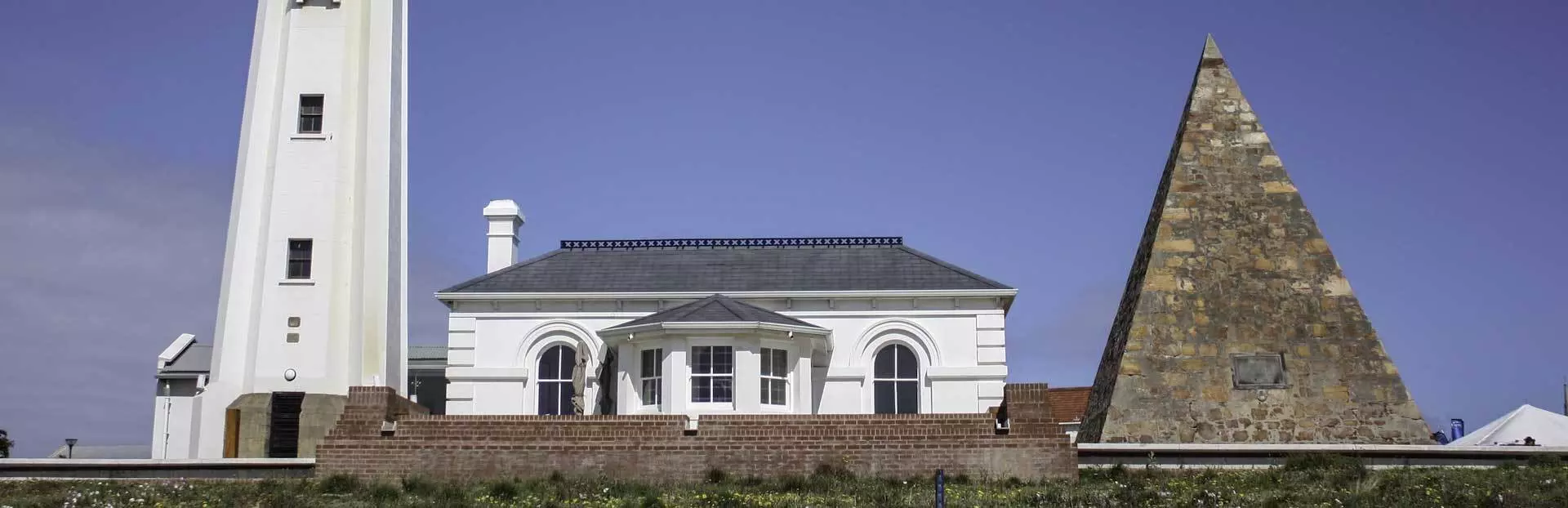
We start on the Donkin Reserve, site of a pyramid monument erected in 1820 by acting Cape Colony governor Sir Rufane Donkin, who was on hand to welcome the settlers. Donkin was in deep mourning following the recent death of his young wife, Elizabeth.
Places are about people, and all the buildings we’ll see are a reflection of the endeavours over almost 200 years of the people who turned this remote corner of Africa into a bustling port city.
If like me you are passionate about history, and especially the courage and tenacity it took for people to carve out a new and successful existence for themselves, then this tour is for you.
You’ll see historic stone churches and a 52-metre-high tower, the Campanile, built to mark the 100th anniversary of the settlers’ arrival. You’ll see a stately City Hall built alongside a market square where for almost 100 years ox-wagons would congregate to sell ivory, animal hides and wool. You’ll see elaborate architectural gems, including a library whose terra cotta façade was manufactured in Britain and shipped out to Port Elizabeth, where it was assembled more than 110 years ago.
This tour features many more fascinating buildings and monuments, views and vistas.
Tour Producer
 Tour Producer

Kin Bentley

Although I wasn’t born in Port Elizabeth, I have lived and worked here since the mid-1980s.
As a journalist, I reported on the anti-apartheid struggle and covered municipal affairs for the Evening Post and later the Eastern Province Herald.
Established in 1845, the Herald is the oldest daily newspaper in the country – and has always been an integral part of the city’s history.
I was actually born 300km up the coast in East London, although my grandparents lived in Port Elizabeth. My grandfather, JC Bentley, was an amateur astronomer. His main claim to fame was helping to establish the Port Elizabeth People’s Observatory. He was instrumental in purchasing the city’s first large telescope from the Royal Observatory in Greenwich, London, in the late-1940s.
When I moved to Port Elizabeth as a young man in 1984, I was overwhelmed by the rich history I found reflected in the buildings in the old part of the city. The longer I’ve lived here, the more I’ve discovered. I’ve been saddened to see some lovely old buildings left to decay, but encouraged by the gallant efforts made to restore others.
The fact that the 1820 British settlers arrived in this bay with some of my ancestors among them intensified my interest in how this city evolved – and in its long and fascinating links with Britain.
While I earned a living reporting on the affairs of the city, and later editing stories for the Herald, I also allowed my art skills – acquired during a four-year fine art diploma course – to find an outlet in the many sketches I have made and photographs I have taken down the years of this special city.
I have produced several fiction and non-fiction books, including an autobiography, “Apartheid’s Child, Freedom’s Son”, and “Port Elizabeth – A Visual History”, almost 1000 pages of text and pictures tracing the town’s development over almost 200 years.
These e-books and quality prints of some of my drawings are available from my website at https://www.kinbentley.co.za.

Save with audio tour passes
How do passes work?

Preview Location
 Preview Location
Location 2
The Donkin Pyramid Memorial
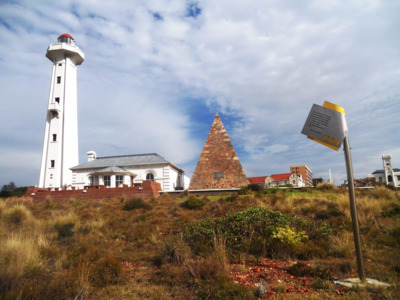
Sir Rufane Donkin ...
 View locations and route

How VoiceMap Works






Major Landmarks
 Major Landmarks
-
Eastern Cape's Fort Frederick
-
Donkin Pyramid and Lighthouse
-
Search Results Web results Port Elizabeth Main Library
-
The Campanile
Getting There
 Getting There
Route Overview
-
Start locationAthol Fugard Terrace, Central, Gqeberha, 6001, South Africa
-
Total distance3km
-
Distance back to start location227m


Directions to Starting Point
You should have no problem finding the starting point of the tour: in Belmont Terrace on the edge of the Donkin Reserve, We start next to the Edward Hotel, one of the city’s most celebrated buildings. Metered and Uber taxis will get you there safely if you don’t have your own transport.
 Show Directions



Tips
 Tips
Tips
Places to stop along the way
There will be places en route which you might want to explore more extensively. These include the historic St Mary’s Cathedral, the Campanile and the Main Library, with its Africana collection.
The tour does not take in the beachfront, where the city’s main museum is to be found at Bayworld. However, the military museum at the Prince Alfred’s Guard drill hall – with exhibits dating back to the 19th century frontier wars – should satisfy most hankerings for history. The Feather Market Centre, accessed from Baakens Street, is spectacular inside, with its massive arched roof and impressive pipe organ. If there is anyone around, just ask if you can take a look around. For a fascinating insight into domestic life in mid-19th century Port Elizabeth, also try to pop into the Number 7 Castle Hill Museum, also known as Parsonage House.
Best time of day
Clearly the best and safest time to do this tour would be during working hours – 8am to 5pm – on a weekday. But there should be no problem walking the area over a weekend. You will, however, find that the delightful coffee shop which concludes the tour is only open during traditional working hours.
However, three hotels close to the Donkin Reserve will surely be open on weekends for food and refreshments. And toilets! Also, please note that Fort Frederick is generally closed over weekends and on public holidays. If the large wooden doors are shut, it means the fort is closed. There is usually a security guard on duty during the week, when it should be safe to enter.
Precautions
The Central part of Port Elizabeth is being steadily upgraded, after a period of inner-city decline. However, do be wary of vagrants in the more remote areas. I have attempted to keep the route clear of these, but in any country you need to be cautious.
However, the overwhelming reception you should experience as you walk around Port Elizabeth is one which befits its Friendly City moniker. For security's sake, it would be preferable to do the tour in a group of two or more, depending on how young and fit you are. Unless you know the area well, solo tours are not advisable.
Get The App
 Get The App




Scan to get app
Download the app for free
VoiceMap




 App of the Day

 Editor’s Choice


 Questions and Reviews